
Discussing and Addressing Complexity (using ERs)
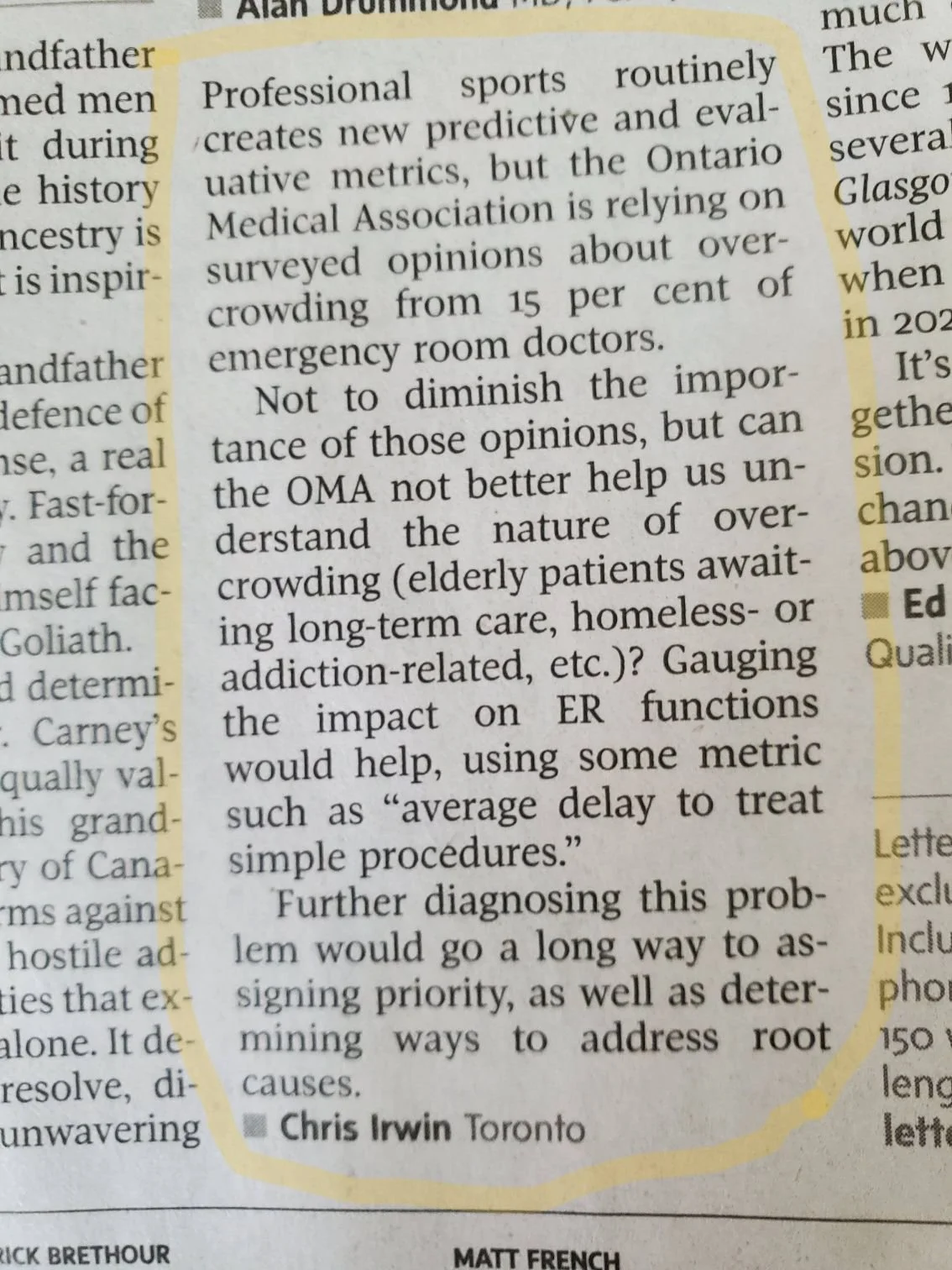
A photograph of my published letter to the editor, Globe and Mail, June 16, 2026
Responses to Complexity
I have written before about the difficulty of developing meaning metrics in the face of complex problems. The crisis in Ontario hospital Emergency Rooms (ERs) fits this bill. The above letter to the editor was published in the Globe and Mail (June 16, 2026), and could be seen as being critical of the Ontario Medical Association and/or the provincial health system. Whether toward news reporting or opinions, our human responses to these crises can take several forms:
Vindicated (See? and I have been sounding the alarm for years!)
Helpless (What is the point in even trying?!)
Distant (There is a lot of data here to dig into!)
Impassioned (We have to do something!)
All of these are understandable, and all can provide helpful perspective. The vindicated may be less likely to stay quiet in the face of resistance next time. The helpless fully embrace the impracticality of "solving" these problems. The distant will take the time for the post-mortem of actions to date. The impassioned can be the force to keep trying despite the challenges.
Spend time in the Comments section where those different perspectives "engage" with each other and you will see the following:
Unsubstantiated claims (often general and always overly simple)
Invitations to substantiate such claims with data
Accusations of arguing in bad faith (when such data does not emerge)
Suggestions that an argument is unquantifiable
Presenting survey/polling data
Dismissing such opinions as biased or useless
Clarifications about underlying logic (often preceded by, "Here's the thing")
Conclusions that the conversation has become impossible (references to “people like you” make an appearance)
Follow-up commentary referencing the valiant attempt to engage
Again, all the above are understandable and each is helpful in illustrating the difficulty of engaging with different perspectives around issues that carry a large degree of complexity.
Useful Classifications
Not to provide a taxonomy for every piece of information, but as we form our thoughts and engage with others, there are classifications that emerge:
Data exists, although we can discuss sources and accessibility.
We all have Experiences, direct or indirect, from sources with varying levels of credibility (and if you believe social psychologists, WE are unreliable witnesses to OUR OWN EXPERIENCES!)
We form Beliefs based on logic shared by others or logic that we form ourselves AND based on our sense of morality, justice, fairness, worldview, etc.
If we want to engage under complexity, Data and Experiences are best shared. The recipient may or may not agree with your ideas and interpretations, and acknowledging those differences is an excellent start.
The logic-based Beliefs are notable because they are easy to put into words. We often term this “educating others” as we share with them how things really work. The other Beliefs can be tough to share because (1) it sits on a level of intuition that we do not fully understand ourselves, and/or (2) putting it into words carries the risk of revealing beliefs that may be controversial or sensitive.
Ideas in Context
Andre Picard in a recent Globe and Mail editorial discusses the crisis taking place in today’s Emergency Rooms (ERs). His commentary is rich with stats and evidence.
Data on ERs:
One in ten patients wait more than 14 hours.
One in thirteen patients leave before receiving care.
One in one thousand patients who come to ER die. (This equates to 16,000 deaths per year.)
Two thirds of patients that present at ER are severe and unstable.
One third of patients have multiple conditions.
Most (unquantified) patients are treated and discharged within 4 days.
One in twelve patients remain in hospital for 44 days.
Experiences from ER patients:
A 79-year-old man in Edmonton waited 90 hours before being admitted to hospital for severe influenza.
A 44-year-old man (again in Edmonton) dies of a heart attack after waiting 8 hours for care.
My 26-year-old son went to the ER with appendicitis. Over his 24-hours in the hallway, the environment was at times chaotic, but the care was excellent.
Knowledgeable people (including Dr. Picard) will share fundamental understanding of the situation. There is a fitting reference to W. Edward Deming about how systems function. One of the long-standing truisms about our healthcare system involves the challenges associated with Alternative Level of Care (ALC) patients, who contribute to the “access block” that constrains the patient flow through places like ER. Dr. Picard shares that between 15 and 30% of hospital beds are taken up by those who do not need to be in hospital. This logic suggests that, amid the complexity, “solving” the ALC problem is a good focus.
My understanding of the ALC problem is that there are people, often seniors, who are living at home with chronic health conditions. The lack of an immediate support network (e.g. adult children living close by) can make the situation more precarious. When something significant does go awry, the ER is a natural first stop, but often the reasons that brought them to ER make it impossible for them to return to their previous independent way of life.
Theories exist away from the full context of the people involved. If for instance, the patient is an elderly person who can no longer live independently, long-term care is an option, but moving in with family members could be realistic. The latter situation may require such physical accommodations as ramps, lifts, and railings, and will also create significant emotional changes for all involved. An increasingly common case is that this person has drug dependencies that include both physical and mental health conditions. If the addiction has created a scenario where all family connections are broken, the list of options shrinks.
Thinking into Action
Not surprisingly, actions and programs start with a particular focus.
A focus on Frail Elderly means Build more Long-term Care.
A focus on Support Networks, means Live Close to Your Family.
A focus on Primary Care means Get a Family Doctor.
A focus on Prevention means Do not Develop an Addiction.
Each of these contains clear logic that has a degree of clear implementation by individuals, by Governments and/or by some other body. Each is also an oversimplification. When Dr. Picard brings in language like “solve,” “fix,” and “root cause,” there is a tendency to follow the logic and “do something.” This can get especially loud for the Governments who take the blame for damaging statistics and constantly hear anecdotal evidence from their constituents.
A massive part of the challenge is resisting the temptation to try to “get to the bottom of it” (complexity has no bottom), while also being decisive about “doing something” even if that thing proves itself to be off the mark once we see its consequences. We need to acknowledge the data that we have and consider the thinking that led us to gather that data in the first place. Looking at “wait times” can presuppose the thinking that shorter is better. If one in thirteen patients is leaving because the wait is too long, perhaps their “emergency” was not an emergency.
Curiosity and Better Questions
The ER data points above can drive us to ask questions, give context to anecdotes and test theories.
To what extent are people coming to ER without seeing (or exploring) other (more suitable) options for care? Is there an opportunity to educate people? We don’t want them to be unwisely fearful of going to ER because they don’t want to be in the way.
If you are really sick, isn’t the ER (hallway or not) a great place to be waiting? For my son, when his appendix was dangerously swollen, I would rather him in the hallway of the ER than back home. (Allow me to confess a reluctance to present in the ER, not so much for fear of being in the way but fearing the chaos and the increased chances of getting sicker by going to the hospital.) “Hallway medicine is bad,” may not always be true.
How useful is the stat of number of deaths from ER visitors? Given that two thirds of visitors to ER are severe and unstable, that could very well be really good number. Just because the number is there doesn’t mean that it provides anything useful.
In my letter to the editor, I proposed creating a sabermetrics-style performance metric like “average delay to treat a simple procedure.” This could involve providing an objective classification that captures conditions that (1) belong in the ER to begin with, and (2) were fairly straightforward to treat. Maybe a young otherwise-healthy adult with appendicitis fits here. This would gauge the extent to which the system was creating greater risk by not picking the low hanging fruit; this is simply a version of medical triaging.
The specifics of this example are far from the point. People with richer understanding than mine could do a much better job of finding good measures. The idea is to find something that lays bare a supportable logic and creates objective evidence with which to evaluate the objective results. We can more easily talk about the thread that we all saw emerge from the chaos.
If systems are perfectly designed to give the results you are seeing, let’s find a result that provides a useful focus. In keeping an eye on that ball, maybe we engineer a way to for ERs to better perform despite the blockers (e.g. ALC patients and the impact of the opioid pandemic). While individual ERs do that, others can work on addressing the systematic issues.