
The Semantics of Leadership
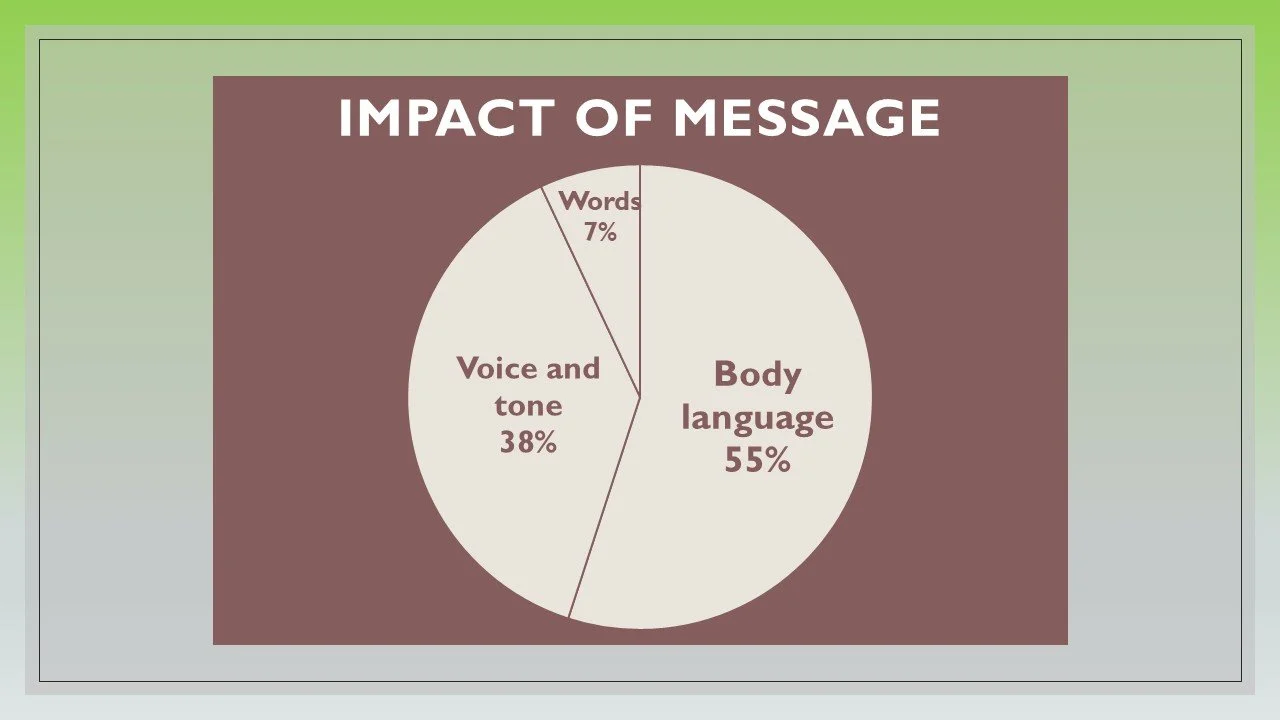
A pie chart of a well-known and often misused research finding
Set-up
You may have seen research findings that claim that in interpersonal communication non-verbal cues (e.g. body language, posture, gestures, etc.) account for more than half of “the message,” while a further sizeable chunk comes from tone and other non-word verbal elements. The point of this appears to be: Make yourself believable and people will believe you.
NOTE: An important detail of this research in the face of an inconsistent message (e.g. your words are saying one thing, but you are giving off a very different vibe), we trust our “guts” more than our ears (and your words).
Such evidence fuels a flavour of Leadership that involves influencing, persuading and “winning over” others. The above research pairs well with Maya Angelou’s wisdom that people don’t remember what you said, they remember how you made them feel. Again, effective leaders foster trust.
WARNING for the AI era: Just like video-replay in sporting events, we can cross-check our recollection of feelings with a transcript or AI-summary.
If we believe the adage, “to be convincing, one must first be convinced,” the words we choose, although of limited effect on the audience, carry weight as demonstrating our own understanding. Armed with certainty, simplicity and clarity, leaders engage and direct their followers.
In a complex environment, where no one person has all the answers, the “Leader as Communicator” approach to loses relevance.
REQUEST: Please re-read that sentence aloud using a calm-but-firm tone of voice and a crisp downward inflection at the end. Picture a speaker whose body position emits confidence, not arrogance; uses minimal hand gestures; demonstrates a warm-yet-serious facial expression. Before continuing, insert a pause that feels like an invitation to engage in a discussion.
A Different Dynamic
STYLE NOTE: I am inserting “prompts” to help me relay my thinking.
Question: Isn’t leadership always about winning people over?
There is a role for “selling” the idea, but that is not helpful when a group must formulate an understanding of a complex situation. Arguably, if you can convince people that a complex situation is “actually quite simple,” you are hindering the necessary process.
Question: So, who makes the decisions?
When a situation is complex, before we “make a decision” we want to better understand. Everyone will have opinions, but no one will be THE expert because no one has seen this exact situation before. Sometimes the best “decision” is to do take the time to better understand rather than engage in a reactive action of dismissal.
Question: So, this is about getting a consensus, right?
Again, but not too soon. Part of the challenge here is slowing things down because we tend to rush to the “What do we need to do?” before surfacing the various and conflicting ways to understand the situation. Acting too soon risks triggering unintended consequences, which can find us “communicating” our way uphill or scrambling for the lipstick when our way forward reveals itself as a pig.
Question: So, who leads this process?
Exactly. There is no one leader. This is why I am looking for a better name for the approach.
Question: I find it much easier to understand things when I hear a clever quote from a famous person. Do you have one of those?
Joe Dumars is on record as saying, “On a good team, the coach holds the players accountable. On a great team, the players hold each other accountable.”
So, what now?
With distinct and well understood problems, expertise prevails. When implementing plans, trained project manager clarify accountability for completing a task, for providing input, for staying abreast of updates or for ensuring that such steps are completed by others.
When situations have many moving parts, before getting to the decisions that launch the implementation, leadership groups must first address the complete (or apparent) situation together. The combined effort to make sense of the situation requires surfacing different areas that deserve attention and resisting the temptation to get others to agree with our understanding of the situation. The specific aspects to surface include:
· What tangible evidence and occurrences do/could we have available?
· What logic do we use to/could understand this evidence?